Gunpowder, Guns and Advanced Weaponry
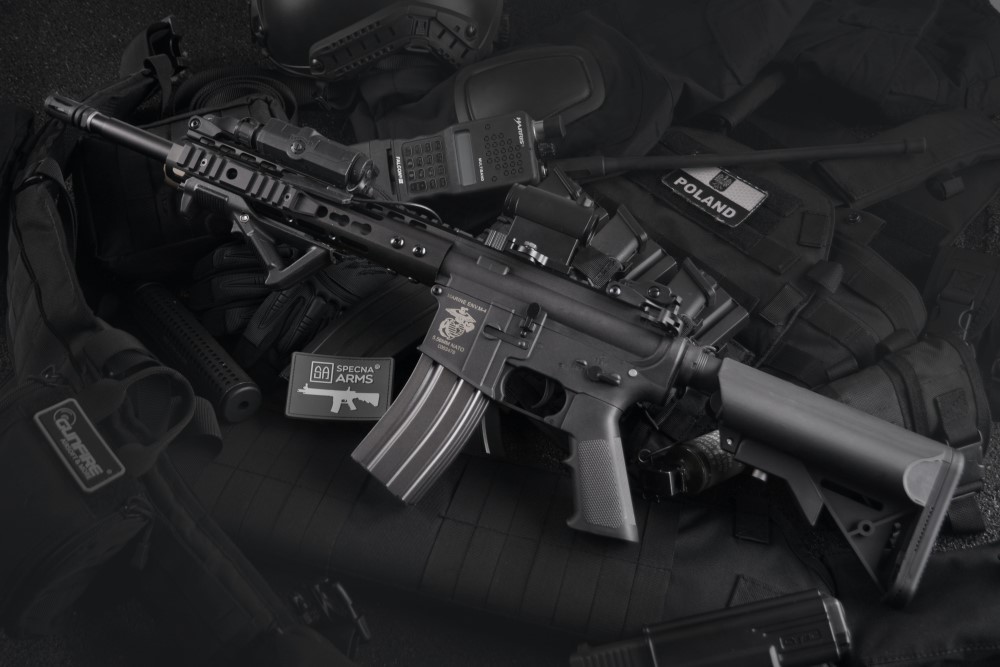
Credits to Specna Arms
Gunpowder, also known as black powder, was invented in China during the Tang Dynasty around the 9th century AD. Its discovery is attributed to alchemists who were trying to find an elixir of immortality but accidentally stumbled upon the explosive properties of saltpeter (potassium nitrate), sulfur, and charcoal.
Initially, gunpowder was used for non-military purposes, such as fireworks, signaling, and in medicine. However, its potential as a weapon was soon realized, and it was adapted for use in firearms.
The first firearms were developed in the 13th century, and they were essentially metal tubes with one end closed and a small hole at the other end. Gunpowder was poured into the closed end, and when ignited, the resulting explosion would propel a projectile out of the open end of the tube. These early guns were called “hand cannons” and were difficult to aim accurately.
As technology improved, guns evolved to become more accurate and easier to use. In the 15th century, the matchlock was invented, which used a slow-burning match to ignite the gunpowder. The matchlock made it easier to aim and fire guns, but it was still slow and prone to misfires.
The flintlock was developed in the 17th century and revolutionized firearms technology. It used a piece of flint to strike a spark, which would ignite the gunpowder and fire the gun. The flintlock was faster, more reliable, and easier to use than previous firearms.
The use of lethal tools for sustenance and family provision can be traced back to the early days of human civilization. In many parts of the world, hunting and gathering were the primary means of survival, and guns became an important tool for procuring food.
In North America, the use of guns for hunting and survival was essential for early settlers. Hunting rifles, such as the Kentucky long rifle, were commonly used in the 18th and 19th centuries. These rifles were designed for accuracy and were often used to hunt game for food.
As society changed, the use of guns for sustenance and family provision became less common. With the rise of industrialization, people began to rely more on agriculture and factory jobs for income, and hunting and gathering became less important for survival.
The development of conservation movements in the late 19th and early 20th centuries also played a role in changing attitudes towards hunting. Hunting began to be seen more as a sport than a necessity, and conservation efforts focused on preserving wildlife populations for future generations.
In the 20th century, the development of firearms technology also played a role in changing attitudes towards hunting. The introduction of more powerful and accurate firearms, such as high-powered rifles and shotguns, made hunting more efficient and accessible. Hunting became more of a leisure activity, and many people began to hunt for sport rather than necessity.
Today, hunting remains an important activity for many people, but it is primarily seen as a leisure activity rather than a necessity for survival. There is still a significant portion of the population that relies on hunting for sustenance, such as indigenous peoples and some rural communities. However, hunting for food is generally seen as an alternative to store-bought meat rather than a necessity.
A little more on the progression of innovation in firearms. In the early 19th century, the percussion cap was developed, which used a small metal cap filled with explosive material to ignite the gunpowder in the barrel. This innovation made it easier to fire guns quickly and accurately. The first successful repeating rifle, the Volcanic, was also developed in the mid-19th century, which could fire multiple shots without the need to reload.
In the late 1800s, the development of smokeless powder replaced black powder, which made firearms more powerful and efficient. This allowed for higher velocity bullets and longer-range shooting, making guns more accurate and lethal.
During the 20th century, the development of semi-automatic and automatic firearms continued to improve the manageability and ease of use of guns. Semi-automatic guns can fire one bullet with each pull of the trigger, while automatic guns can continuously fire bullets as long as the trigger is held down. These firearms became increasingly popular for military use, and in some cases, for civilian use as well.
As firearms technology improved, the predominant use for guns shifted from military use to civilian use. Hunting and sport shooting became popular pastimes, and guns were also used for self-defense.
However, guns remained a controversial topic, and debates about gun control and the Second Amendment have continued for decades. The impact of gun use on society, the military, and international dynamics has been vast and complex. Guns have played a significant role in shaping human history and continue to do so.
In terms of military impact, guns have revolutionized warfare. The development of firearms has changed the way wars are fought and has led to more efficient and deadly combat. Guns have been used to conquer territories, defend borders, and suppress rebellions. The introduction of automatic weapons and other weapons such as tanks, and armed fighter planes made it easier for soldiers to engage in warfare, but it has also made war more lethal and devastating. In many cases, the use of guns in warfare has resulted in massive casualties and destruction. The development of firearms technology continued to shape military tactics and played a significant role in both World War I and World War II. The development of nuclear weapons brought the threat of global annihilation, which has had a profound impact on international relations and diplomacy. The arms race between the United States and the Soviet Union during the Cold War also had a significant impact on international dynamics.
Beyond firearms used in one-on-one scenarios, there have been significant additional developments in military technology that have transformed modern warfare. These developments have led to innovations that have revolutionized the way wars are fought, but they have also had profound consequences.
One of the most significant developments in modern warfare has been the introduction of drones. Drones are unmanned aerial vehicles that can be used for surveillance, reconnaissance, and targeted strikes. They have been used extensively by the United States military in conflicts in Iraq, Afghanistan, and Pakistan. The use of drones has enabled the military to conduct targeted strikes against enemy combatants, but it has also raised concerns about civilian casualties and the ethics of remote warfare.
Another significant development has been the use of cyberwarfare. Cyberattacks can be used to disrupt or disable enemy communications, infrastructure, or military operations. They can also be used to steal information or conduct espionage. The use of cyberattacks has become increasingly common in modern warfare, with countries such as the United States, Russia, and China all investing heavily in this area.
Advances in missile technology have also transformed modern warfare. Ballistic missiles can be used to deliver nuclear, chemical, or biological weapons, and they have the potential to cause catastrophic damage. The development of missile defense systems has been a major priority for many countries around the world, as they seek to protect themselves from missile attacks.
All of these developments in military technology have had significant consequences for the world. The use of drones has raised concerns about civilian casualties and the ethics of remote warfare. Cyberattacks have the potential to disrupt entire countries and cause widespread damage. Missile technology has the potential to cause catastrophic damage on a global scale.
The development of military technology beyond firearms has led to significant innovations in modern warfare. These innovations have had profound consequences for the world, raising ethical, moral, and legal questions about the use of technology in warfare. As technology continues to advance, it is likely that the use of technology in warfare will become even more complex and nuanced.
The use of guns has also had a significant impact on society. Guns have been used for self-defense, hunting, and sport shooting. They have become deeply ingrained in some cultures, and gun ownership has become a symbol of personal freedom and individual rights. However, the widespread availability of guns has also led to gun violence, accidents, and crime. The debate about gun control and the regulation of firearms ownership has become a controversial and divisive issue in many countries.
In addition to military, geopolitical and societal impacts already mentioned, guns have also had a significant impact on crime and violence. The availability of guns has been linked to higher rates of homicide, suicide, and accidental shootings. Gun control measures have been implemented in many countries around the world to try to mitigate these risks, but the debate about gun control remains controversial.
On the other hand, guns have also played a role in self-defense and personal protection. Many people choose to own guns for self-defense purposes, believing that it provides them with a sense of security and protection.
Overall, the impact of gun use on society, the military, and world interdynamics between countries is complex and multifaceted. While guns have played a significant role in shaping human history and modern civilization, they have also been the cause of much suffering and destruction. The continued debate about gun control and firearms regulation highlights the ongoing struggle to balance the benefits and risks of gun ownership and use.